Homophones
Hello,
More tricky spellings!
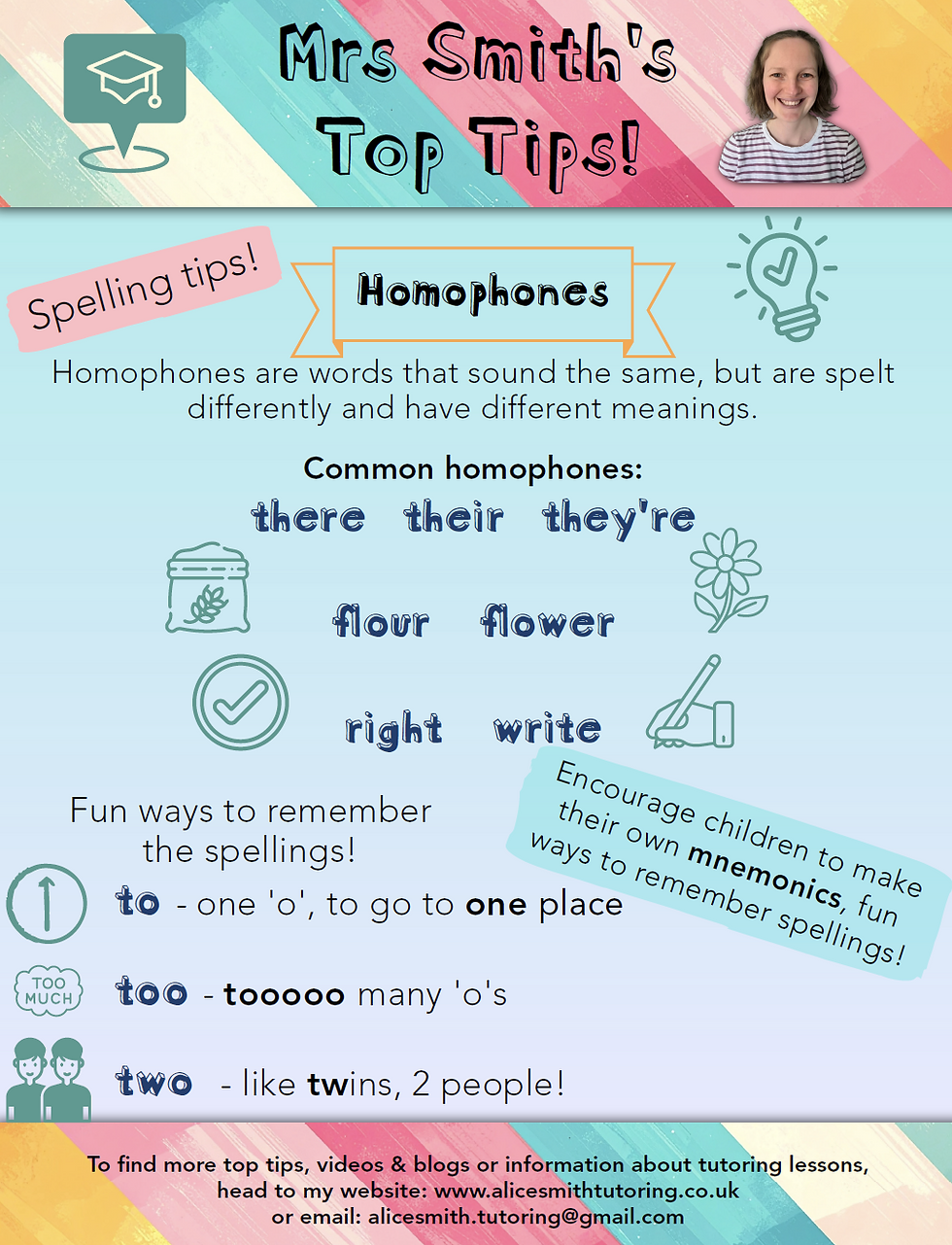
Homophones are words that sound the same, but are spelt differently and have different meanings. Even as adults we often get some of these spellings wrong!
There are many homophones, bu
t some of the most common are:
there their they're
to too two
where wear we're (depending on pronunciation)
which witch
break brake
weather whether
With homophones, context is key. To know, for example, which 'weak' to spell, you need to know the sentence. Is it:
The man felt weak after his run. Or: Next week we will go on holiday.
Learning homophones requires good memory and recall skills, to remember which is the correct spelling. For some children this is hard. Seeing the word written down can help them learn it, for others they need to write it themselves.
The best way to remember which spelling they need is to learn some mnemonics (see my blog for more details!): fun ways to remember them.
For example:
bored - "I'm so bored, could we play this game or that game?"
board - "The rowing oar was made of wood, and so was the wooden board."
to - one 'o', to go to one place
too - tooooo many 'o's
two - like twins, 2 people!
They can also come up with their own fun ways to remember the spellings!
Drawing images, or writing a song or rhyme can help reiterate the learning.
You could also play some fun games:
Charades: act out homophones and they have to guess which you're acting, for example tail or tale.
Pairs: write the homophones and their definitions, image or context on individual cards. Turn them face down, then the child can turn over two at a time, trying to find the correct pairs.
Write the homophones on post it notes. Say a sentence containing the homophone, can they choose the correct spelling? Swap roles, can they put the word into a sentence, and identify if you provide the correct spelling?
Write sentences with the homophone missing, can they work out the correct spelling for the gap?
As with a lot of learning, repetition is key! Encourage your child to keep practising any homophones they regularly get wrong. Encourage them to identify it whenever they're reading and look out for it in different contexts.
Feel free to drop me an email or book a free call for any specific help you might want or if you'd be interested in booking tutoring or home-education lessons for your child.
I look forward to starting our learning journey together!
Alice


